

Blog
What Is 5-AMINO-1MQ? Is It a Peptide?

5-AMINO-1MQ is a synthetic small-molecule research compound, not a peptide. Its name is shorthand for 5-amino-1-methylquinolinium. It appears in the scientific literature as an inhibitor of nicotinamide N-methyltransferase, usually abbreviated NNMT. Finding it in a research-peptide catalog does not change its chemical classification.
This guide explains the name, the distinction between a small molecule and a peptide, and what to check when reviewing a research listing. It discusses laboratory research only and does not provide dosing or personal-use guidance.
Is 5-AMINO-1MQ a peptide?
No. Peptides contain amino-acid residues joined through peptide bonds. IUPAC defines the class by that chemical structure, rather than by a product’s packaging or the type of catalog in which it appears. See IUPAC’s definition of peptides.
5-AMINO-1MQ belongs to a different structural class: a substituted methylquinolinium compound. The word “amino” refers to a chemical group; it does not mean the compound is an amino-acid chain. The medicinal-chemistry literature describes quinolinium scaffolds among the small molecules investigated for NNMT inhibition. Read the original structure–activity study.
What does the name 5-AMINO-1MQ mean?
You may encounter the spellings 5-AMINO-1MQ, 5-Amino-1MQ and 5A1MQ. The abbreviated name points to the methylquinolinium scaffold and its amino substitution. Spacing and capitalization can differ between a paper and a supplier listing.
A similar-looking name is a starting point for identification, not a complete specification. Before comparing research materials, check the full chemical designation and any stated salt or counter-ion. Do not assume that differently specified forms have interchangeable molecular weights or analytical results.
What is NNMT, and why does it appear in the research?
NNMT stands for nicotinamide N-methyltransferase. It is an enzyme involved in transferring a methyl group from S-adenosylmethionine (SAM) to nicotinamide, producing 1-methylnicotinamide. Researchers use enzyme inhibitors as experimental tools to investigate a target and its associated biochemical pathways.
The 2017 study by Neelakantan and colleagues compared related small-molecule structures and measured their inhibition of NNMT. That type of structure–activity research asks how changes to a molecule affect its behavior in a defined assay. It does not establish a consumer benefit or a specification for a commercially supplied vial. View the study on PubMed.
A 2024 paper by Babula and colleagues studied the NNMT inhibitor described as 5A1MQ in a mouse model and examined its distribution and other experimental measurements. Its findings belong to that model and study design. Animal research does not establish safety or effectiveness for people, and the paper is not a test report for VialBench’s inventory. View the 2024 research record.
What should a laboratory check before ordering?
Keep the published research question separate from the specifications of the material being purchased. A useful review includes:
- Identity: the full compound name and any specified chemical form.
- Quantity: the listed amount per vial and the number of vials required for the laboratory’s work.
- Documentation: any available certificate of analysis, including its sample, lot identifier, date and methods.
- Analytical scope: which properties were actually measured, rather than inferred from the product name.
- Availability: the current options and stock status on the product page.
A purity percentage, an identity result and a quantity measurement answer different questions. A research publication also cannot substitute for documentation about a particular sample. For background on interpreting these distinctions, see our guide to reading a research COA and explanation of purity versus content. Those guides do not certify this product or replace compound-specific documentation.
Shop 5-AMINO-1MQ research material
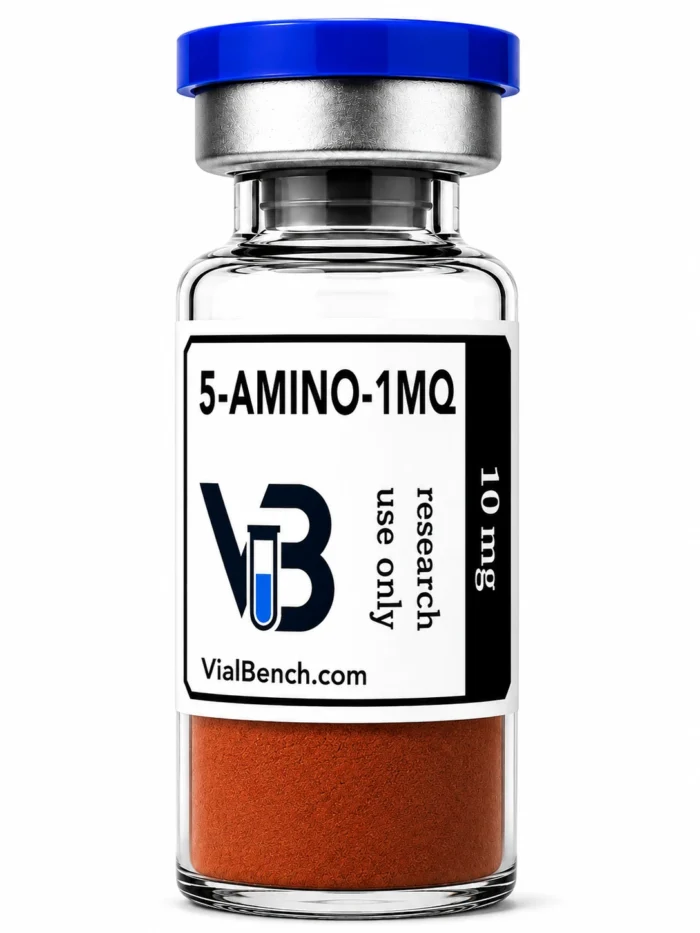
VialBench lists VB-5-AMINO-1MQ in 10 mg and 50 mg vial options. Select the appropriate option on the product page to see current pricing and availability, and review the description for available documentation. Listed milligrams describe the catalog quantity per vial; they are not dosing instructions.
View 5-AMINO-1MQ options and current availability →
Frequently asked questions
Does “amino” mean 5-AMINO-1MQ is a peptide?
No. An amino group and an amino-acid chain are different chemical features. The compound is classified as a small molecule.
Are the 10 mg and 50 mg options different compounds?
They are listed vial-quantity options for VB-5-AMINO-1MQ, rather than different peptide sequences. Review the selected option and available documentation before ordering.
Does a published study verify the product I am buying?
No. A publication describes the material and experiments reported by its authors. It does not establish the identity, purity or quantity of a separate supplier’s inventory.
References
- IUPAC. Peptides — Compendium of Chemical Terminology (Gold Book).
- Neelakantan H, et al. Structure-Activity Relationship for Small Molecule Inhibitors of Nicotinamide N-Methyltransferase. Journal of Medicinal Chemistry. 2017;60:5015–5028. DOI: 10.1021/acs.jmedchem.7b00389.
- Babula JJ, et al. Nicotinamide N-methyltransferase inhibition mitigates obesity-related metabolic dysfunction. Diabetes, Obesity and Metabolism. 2024;26:5272–5282. DOI: 10.1111/dom.15879.
Published by VialBench Research, a supplier of laboratory research materials. Product links are commercial links to our own catalog. The cited publications do not endorse VialBench or establish results for its products.
All products sold on this website are intended for research and identification purposes only. These products are not intended for human dosing, injection, or ingestion.