

Blog
Why Identical Peptide Samples Can Produce Different Research Results

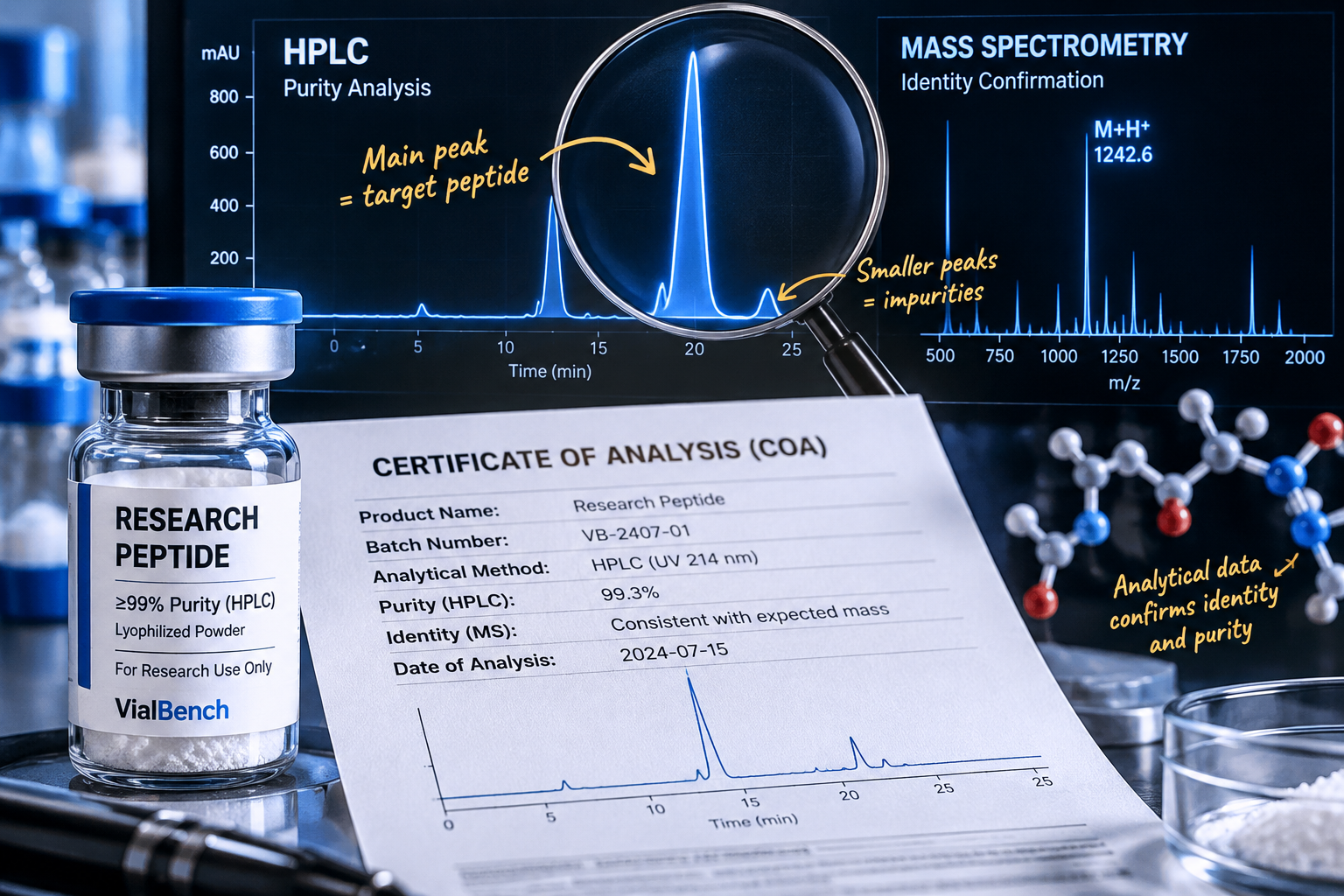
Two laboratories can study the same peptide and still observe different results. Sometimes, the explanation begins before the experiment does.
Reproducibility is a fundamental challenge in scientific research.
Even when investigators follow similar protocols, differences in material preparation, storage history, analytical characterization, and experimental conditions can influence the outcome.
Peptides present an especially interesting case because their chemical structures and stability characteristics can vary substantially.
Understanding those differences is essential to interpreting research data.
The Hidden Variable: Sample History
A laboratory sample has a history before it reaches the experiment.
That history may include synthesis, purification, packaging, transportation, storage, and preparation.
Each stage introduces conditions that may affect material characteristics.
For example, some peptides may be sensitive to oxidation, hydrolysis, aggregation, or other chemical and physical changes.
Not every peptide responds to these conditions in the same way.
A handling procedure suitable for one compound may be inappropriate for another.
Why Peptide Structure Matters
Peptides consist of amino acids connected through peptide bonds.
Their behavior depends on factors including amino acid sequence, molecular structure, charge, solubility, and surrounding conditions.
Some sequences contain residues that are particularly susceptible to specific chemical reactions.
Others may be prone to aggregation under certain experimental conditions.
This means that stability cannot be reliably predicted from the word “peptide” alone.
Researchers need information relevant to the actual compound under investigation.
Four Variables That Can Affect Research Consistency
1. Temperature
Temperature can influence the rates of chemical reactions and physical changes.
For some materials, prolonged exposure to unsuitable temperatures can affect stability.
However, there is no universal storage temperature appropriate for every peptide formulation.
2. Moisture
Water can participate in degradation reactions and affect the physical properties of certain materials.
The importance of moisture depends on the peptide, formulation, packaging, and storage environment.
3. Light and oxygen exposure
Certain compounds may be sensitive to light or oxidation.
Packaging and handling conditions can therefore be relevant to maintaining sample integrity.
4. Preparation and experimental conditions
Solvent composition, pH, concentration, and contact with laboratory surfaces can influence peptide behavior.
These variables may also affect analytical measurements and experimental reproducibility.
Why Appearance Doesn’t Tell the Whole Story
A laboratory sample may appear unchanged even when its chemical composition has changed.
Conversely, a visible change does not necessarily identify the underlying cause.
Appearance alone is therefore an unreliable substitute for appropriate analytical characterization.
Depending on the research question, methods such as chromatography, mass spectrometry, or other validated techniques may be needed to investigate sample integrity.
The Importance of Lot-to-Lot Consistency
Researchers often focus on whether a material meets a stated specification.
But consistency between lots can be equally important, particularly when comparing experiments performed over time.
Changes in impurity profiles, composition, or sample preparation can introduce variables that complicate interpretation.
Maintaining accurate batch records and analytical documentation can help researchers identify potential sources of variation.
Better Documentation, Better Science
A reproducible experiment depends on understanding more than the final measurement.
Useful laboratory records may include:
- Material identity and batch number
- Available analytical characterization
- Storage and handling history
- Preparation conditions
- Relevant experimental parameters
These details help other researchers evaluate whether differences in results reflect the phenomenon under study or differences in the materials and methods.
The Bigger Picture
Peptide research continues to evolve, and increasingly sophisticated analytical tools make it possible to investigate materials in greater detail.
But advanced instruments cannot compensate for missing documentation or poorly controlled experimental variables.
Reliable research begins with knowing what material was studied, how it was characterized, and what happened to it before the experiment.
That principle applies whether a laboratory is investigating fundamental peptide chemistry, molecular interactions, or analytical methodology.
VialBench Research Library — For educational and laboratory research purposes only. Not intended as instructions for human or veterinary use.