

Blog
How Long Do Research Peptides Last?

One of the most common questions researchers ask is:
“How long will my research peptides remain stable?”
The answer depends on several factors, including whether the peptide is still lyophilized (freeze-dried) or has already been reconstituted, the storage temperature, exposure to moisture, light, oxygen, and the specific characteristics of the peptide itself.
Understanding these variables helps researchers preserve sample integrity, reduce degradation, and improve the reproducibility of laboratory experiments.
Why Are Most Research Peptides Lyophilized?
The majority of research peptides are supplied as a lyophilized powder, sometimes referred to as freeze-dried powder.
Lyophilization removes water from the peptide under carefully controlled conditions by freezing the material and reducing pressure so that ice transitions directly into vapor (sublimation). The result is a dry, stable material that is significantly less susceptible to many of the degradation pathways that occur in solution.
Removing water slows numerous chemical reactions, including hydrolysis, and also limits microbial growth, making lyophilization one of the most effective methods for preserving peptide stability during long-term storage.
For this reason, virtually all commercial research peptides are distributed in lyophilized form rather than pre-mixed into solution.
What Causes Peptides to Degrade?
Although peptides are remarkably stable when stored properly, they can gradually degrade when exposed to unfavorable conditions.
Factors that influence stability include:
- Heat
- Moisture
- Oxygen
- Light exposure
- Repeated freeze-thaw cycles
- Contamination during handling
- Time in solution
Different peptides degrade at different rates, and researchers should always consider the properties of the specific compound being investigated.
Recommended Storage Temperatures
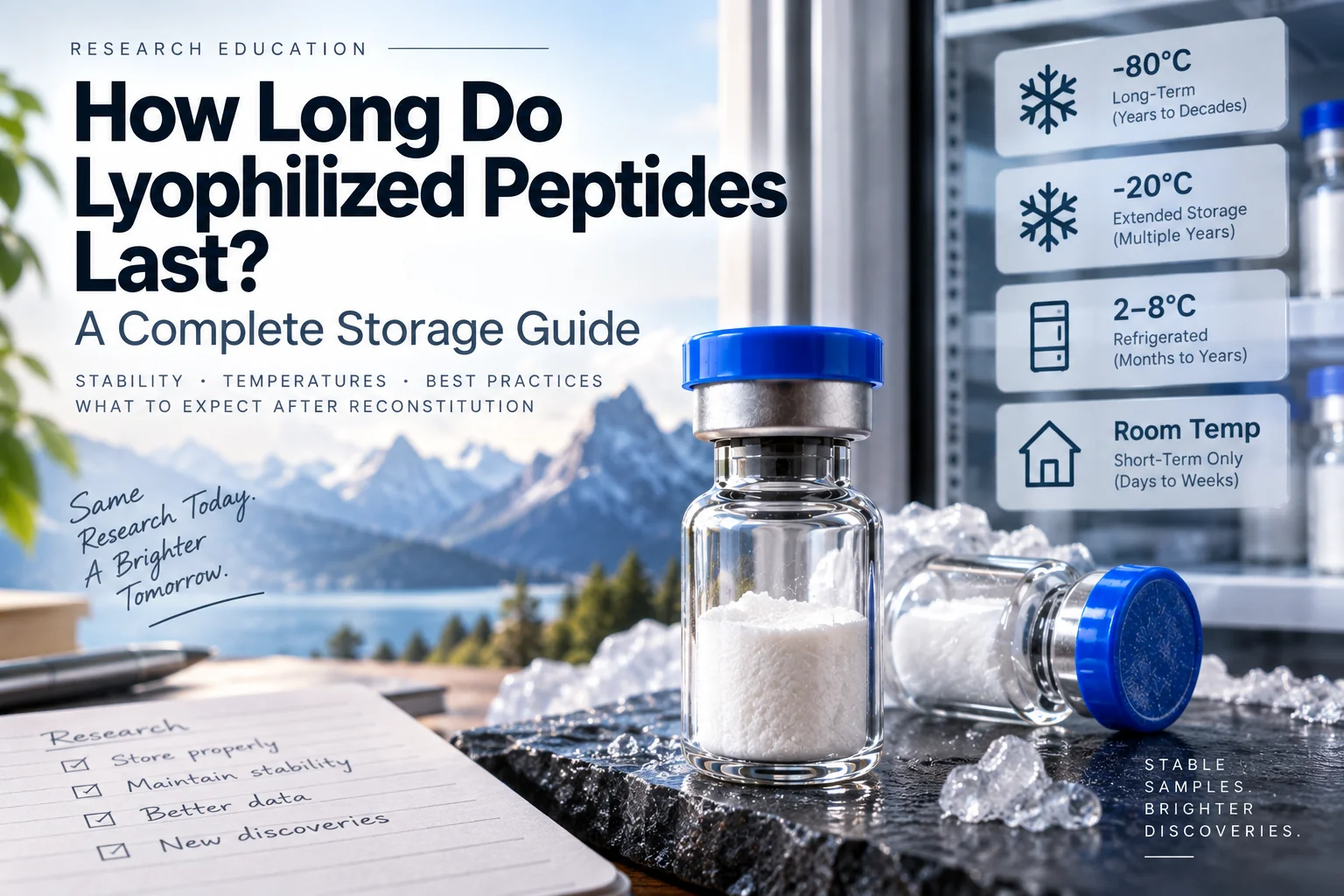
Room Temperature (Short-Term)
Lyophilized peptides generally tolerate short periods at room temperature during shipping or laboratory handling.
However, room-temperature storage should be minimized whenever practical, particularly for extended periods.
Most laboratories recommend transferring peptides to refrigerated or frozen storage after receipt.
Refrigerated Storage (2–8°C)
Refrigeration is commonly used when peptides will be utilized within the near future.
Under appropriate laboratory conditions, many lyophilized peptides remain chemically stable for months to several years when refrigerated in sealed containers protected from moisture and light.
This temperature range offers an excellent balance between accessibility and long-term preservation for frequently used laboratory materials.
Frozen Storage (-20°C)
Freezer storage is considered the preferred method for preserving most lyophilized research peptides.
At approximately -20°C, chemical degradation slows substantially, allowing many peptides to maintain stability for multiple years when protected from moisture and repeated warming.
Many research laboratories routinely archive peptide libraries under these conditions.
Ultra-Low Temperature Storage (-80°C)
For archival storage, many research institutions utilize -80°C laboratory freezers.
Published stability studies and long-standing laboratory practice indicate that properly prepared lyophilized peptides stored continuously at ultra-low temperatures may remain stable for extremely long periods—potentially decades in some cases.
Actual stability depends on the individual peptide, storage container, environmental conditions, and the absence of repeated freeze-thaw exposure. Researchers should always evaluate stability within the context of their specific application and available analytical data.
What Happens After Reconstitution?
Once a peptide has been reconstituted with an appropriate laboratory solvent, stability changes considerably.
In solution, peptides become more susceptible to:
- Hydrolysis
- Oxidation
- Enzymatic degradation
- Adsorption to container surfaces
- Microbial contamination if improperly handled
For this reason, reconstituted peptides generally have significantly shorter usable storage periods than their lyophilized counterparts.
Many laboratories prepare only the amount required for immediate research or divide freshly prepared solutions into multiple aliquots to reduce repeated freeze-thaw cycles.
Should Reconstituted Peptides Be Frozen?
In many research settings, aliquoting reconstituted peptide solutions before freezing is considered best practice.
Rather than repeatedly thawing the same vial, researchers prepare multiple smaller aliquots so each portion experiences only a single thaw before use.
This approach minimizes degradation associated with repeated temperature cycling and helps preserve sample consistency across experiments.
Avoid Repeated Freeze-Thaw Cycles
Repeatedly warming and re-freezing peptide solutions can accelerate degradation.
Instead, researchers often:
- Prepare multiple aliquots
- Label preparation dates
- Store aliquots separately
- Thaw only the quantity needed for a single experiment
These practices help maintain sample quality while reducing unnecessary exposure to changing environmental conditions.
Additional Storage Best Practices
To maximize stability, researchers commonly:
- Keep vials tightly sealed.
- Protect samples from moisture.
- Minimize exposure to light.
- Avoid prolonged room-temperature storage.
- Handle samples using clean laboratory techniques.
- Clearly label storage dates and batch information.
- Store peptides in stable temperature environments with minimal fluctuations.
Good laboratory practices can have as much impact on sample integrity as storage temperature itself.
General Stability Expectations
Although stability varies by peptide and formulation, the following represents a broad overview of common laboratory expectations for properly stored research peptides:
|
Storage Condition |
General Stability |
|---|---|
|
Room temperature |
Days to weeks (short-term handling only) |
|
Refrigerated (2–8°C) |
Months to several years (lyophilized) |
|
Frozen (-20°C) |
Multiple years (lyophilized) |
|
Ultra-low freezer (-80°C) |
Potentially decades under ideal laboratory conditions (lyophilized) |
|
Reconstituted solutions |
Generally much shorter than lyophilized powders; varies by peptide and storage conditions |
These are general expectations and should not be interpreted as guaranteed shelf lives for every peptide.
The Bottom Line
Proper storage is one of the simplest ways researchers can preserve the integrity of peptide materials.
Lyophilization provides excellent long-term stability by removing water, while refrigeration and freezing further slow degradation. For long-term archival purposes, ultra-low temperature storage has been shown in laboratory practice to preserve many lyophilized peptides for exceptionally long periods when handled appropriately.
By combining appropriate storage temperatures with careful laboratory handling—including moisture protection, aliquoting, and minimizing freeze-thaw cycles—researchers can maximize sample quality and improve the consistency of experimental results.